ZIMBABWE’S FUEL PRICE BATTLE: IS THE IRAN WAR THE WHOLE STORY?
Temba Mliswa links Zimbabwe’s rising diesel prices to the Iran conflict and global oil pressures. Mawarire Mbizvo Jealous challenges that explanation, pointing to domestic taxes, fuel policies and pricing as farmers face rising production costs.

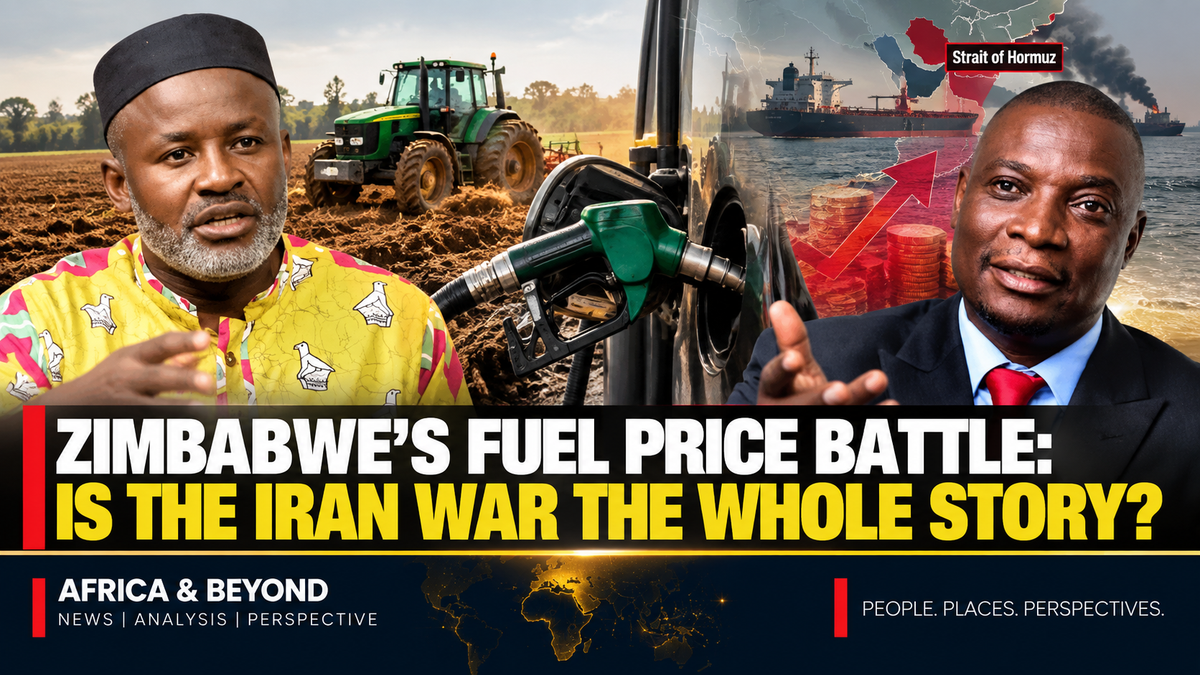
Zimbabwean farmers are facing a fuel-price crisis at precisely the time they need diesel most.
The Zimbabwe Energy Regulatory Authority (ZERA) now puts the maximum price of Diesel 50 at US$2.08 per litre, while blended petrol is priced at US$2.06.
The increase has triggered a debate over who — or what — is responsible.
Former Norton legislator Temba Mliswa has blamed the international oil shock, pointing to the conflict involving Iran and disruption around the Strait of Hormuz.
But a critical response from Mawarire Mbizvo Jealous asks a more uncomfortable question:
Is Zimbabwe really doing everything it can to protect its own economy from an international fuel shock?
That question becomes particularly difficult to ignore when Zimbabwe's diesel price is compared with Zambia's.
As of September 21, Zambia's diesel price was approximately US$1.38 a litre, compared with Zimbabwe's US$2.08. That is a difference of 70 US cents per litre, or roughly 51 percent of Zambia's price.
The international oil market affects both countries.
So why is the gap so large?
MLISWA: BLAME THE WAR
Mliswa's argument is straightforward.
A conflict involving one of the world's major oil-producing regions has disrupted energy markets and created uncertainty around the movement of petroleum through the Strait of Hormuz.
International crude prices have risen sharply during the crisis, putting pressure on countries that import refined petroleum products.
For Zimbabwe, the consequences are being felt at filling stations and, increasingly, on farms.
Mliswa argues that farmers are being squeezed by higher diesel costs just as they prepare for the summer agricultural season.
The Zimbabwe Farmers Union has separately warned about rising fuel, energy and fertiliser costs and called for producer prices to be reviewed. ZFU president Dr Jameson Jawi said mechanisation and irrigation were becoming unaffordable for many producers.
So Mliswa is not wrong that the international oil shock matters.
The bigger question is whether that is where the explanation should end.
MAWARIRE: LOOK AT ZIMBABWE TOO
Mawarire's response takes the argument in a different direction.
His point is that Zimbabwe cannot simply point to Iran every time fuel prices rise without examining the costs created by its own policies.
He compares Zimbabwe with Zambia and points to the striking difference in diesel prices.
Zambia's Energy Regulation Board uses a Cost-Plus Pricing Model that incorporates the cost of petroleum feedstock, transportation, storage, financing, taxes, margins and other costs into the price calculation.
The current Zambian diesel price is around US$1.38 per litre.
Zimbabwe's is US$2.08.
That difference deserves more than an explanation based solely on an international war.
ZIMBABWE HAS INFRASTRUCTURE THAT SHOULD HELP
There is another important part of this debate.
Zimbabwe is not simply a country where every litre of fuel has to travel by road from the coast.
Zimbabwe has access to the Beira–Feruka–Msasa petroleum pipeline, which historically has supplied the majority of imported fuel. WTO documentation records that most fuel entered through the pipeline, with smaller volumes arriving by road or rail.
That infrastructure should, in principle, provide an important logistical advantage compared with transporting every litre by road.
The pipeline reduces dependence on long-distance road haulage and provides a direct route from Beira into Zimbabwe.
So the question becomes even more important:
Why is Zimbabwe's pump price still so far above Zambia's?
The answer cannot simply be that Zimbabwe is landlocked.
Both countries are.
It cannot simply be that international oil prices are high.
Both countries face the same global oil market.
And it cannot simply be blamed on the distance fuel travels.
Zimbabwe has a major petroleum pipeline from Beira.
THIS IS WHERE POLICY ENTERS THE STORY
The fuel price is not determined by crude oil alone.
It is the result of a chain of costs and policy decisions.
Zimbabwe's fuel pricing system includes taxes and levies alongside the underlying imported fuel cost.
A March 2026 Zimbabwe National Chamber of Commerce analysis estimated that taxes and levies accounted for approximately 30 percent of fuel prices, warning that the tax burden amplifies global oil-price shocks and raises production costs across the economy.
In April, government temporarily removed several diesel taxes and levies as international prices surged. KPMG reported that the suspension covered excise duty, the ZINARA road levy, carbon tax and the strategic reserve levy, together amounting to approximately US$0.54 per litre at the time.
That is significant.
It demonstrates that a substantial part of the fuel-price burden is influenced by domestic policy.
If government can remove those charges during a crisis, then government also has choices about how much of the international shock is passed on to consumers and producers.
ZAMBIA SHOWS THAT POLICY CAN CHANGE THE EQUATION
Zambia provides an important regional comparison.
During the 2026 international fuel crisis, the Zambian government temporarily zero-rated VAT and suspended excise duty on imported diesel and petrol. The measures were explicitly presented as a way of cushioning consumers and businesses from rising global oil prices.
Zambia subsequently extended the tax relief through September 2026.
Its Energy Regulation Board also uses a cost-plus system that incorporates procurement, transport, storage, margins, taxes and other identifiable costs into the pump-price calculation.
And Zambia's government says reforms to its fuel-supply system, including increased competition through the TAZAMA pipeline's open-access framework, have helped reduce transport costs and improve the petroleum market.
Whatever political interpretation one places on those policies, the economic fact is clear:
Zambia has used policy tools to reduce the transmission of global fuel shocks to domestic consumers.
Zimbabwe has also used temporary tax relief, but the current diesel price demonstrates that the relief has not prevented a substantial burden from returning to consumers.
THE 70-CENT QUESTION
The most striking figure in this debate is therefore not the price of crude oil.
It is the difference between neighbouring countries.
Zambia: approximately US$1.38/litre.
Zimbabwe: US$2.08/litre.
Difference: approximately US$0.70/litre.
That difference does not automatically prove that Zimbabwe's government is solely responsible for the gap.
The two countries have different supply arrangements, currencies, tax systems, procurement structures and markets.
But it makes it difficult to argue that the international oil shock explains the entire difference.
The domestic policy framework matters.
THE COST IS NOW REACHING THE FARM
This is where the fuel debate becomes an agricultural crisis.
A tractor consumes diesel.
An irrigation pump consumes energy.
A truck transporting fertiliser consumes diesel.
A truck taking grain or vegetables to market consumes diesel.
A farmer cannot escape the fuel price simply because the farm itself is far from a filling station.
And when fuel costs rise while producer prices remain under pressure, the farmer's margin gets squeezed from both sides.
The ZFU has already warned that rising production costs are undermining agricultural viability.
This is particularly dangerous in a season when Zimbabwe may need more irrigation, not less.
A GOVERNMENT CANNOT CONTROL THE WAR — BUT IT CAN CONTROL POLICY
This is perhaps the central issue exposed by the debate.
Zimbabwe cannot control what happens in the Strait of Hormuz.
It cannot determine the global price of crude oil.
It cannot stop international shipping costs from rising.
But it can decide how much domestic taxation is placed on fuel.
It can decide how efficiently fuel is imported.
It can decide how its strategic reserves operate.
It can regulate the market.
It can improve competition.
It can negotiate infrastructure costs.
It can determine whether productive sectors such as agriculture receive temporary targeted relief.
And it can decide whether its fuel-pricing system is transparent enough for citizens to understand exactly what they are paying for.
Those are domestic policy choices.
WHEN POLICY FAILURE BECOMES AN ECONOMIC COST
The strongest criticism of Zimbabwe's approach is therefore not that government caused the Iran conflict.
It did not.
The criticism is that an external shock exposes the weaknesses of the domestic economic system.
If one country can face the same global oil market and maintain diesel at around US$1.38 while another reaches US$2.08, then policymakers have to examine what happens between the international market and the final consumer.
That means looking at taxation.
It means looking at margins.
It means looking at procurement.
It means looking at infrastructure.
It means looking at competition.
And it means asking whether policy is designed to protect productive sectors or simply to collect revenue when the economy is already under pressure.
THE GOVERNMENT'S OWN NUMBERS MAKE THE QUESTION HARDER TO IGNORE
The government has already demonstrated that it can intervene.
Zimbabwe temporarily suspended diesel taxes worth approximately US$0.54 a litre earlier this year.
If those charges can be removed when circumstances become severe, policymakers have to explain why the country should accept a diesel price of US$2.08 when a neighbouring country is selling at approximately US$1.38.
The answer may involve several factors.
But simply saying “Iran” is not enough.
THIS IS ALSO ABOUT COMPETITIVENESS
Fuel is a foundational input across the economy.
When diesel becomes expensive:
Agriculture becomes more expensive.
Transport becomes more expensive.
Manufacturing becomes more expensive.
Mining becomes more expensive.
Food distribution becomes more expensive.
And ultimately consumers pay.
This creates an economic multiplier effect.
A high fuel price is not just a problem for motorists.
It can become a tax on virtually every productive activity.
ZIMBABWE NEEDS TO ASK A HARDER QUESTION
Mliswa has drawn attention to a real external shock.
Mawarire has challenged Zimbabweans to look beyond the international explanation.
The evidence suggests that both dimensions matter.
But the regional comparison makes one point unavoidable:
Zimbabwe has domestic policy choices that can either amplify or soften an international fuel shock.
Zambia's current diesel price of approximately US$1.38 demonstrates that countries exposed to the same global energy market can produce substantially different outcomes through their pricing, taxation and supply policies.
The issue facing Zimbabwe is therefore not whether the Iran conflict exists.
It does.
The issue is whether Zimbabwe's response to that external shock is economically intelligent enough to protect farmers, businesses and consumers.
AFRICA & BEYOND PERSPECTIVE
The war in Iran may have pushed global oil prices higher.
But Iran did not design Zimbabwe's fuel-tax system.
Iran did not set Zimbabwe's domestic levies.
Iran did not determine Zimbabwe's fuel-market structure.
Iran did not decide how Zimbabwe uses its pipeline infrastructure.
Those are Zimbabwean policy questions.
And that is why the debate sparked by Temba Mliswa's post should not end with blaming a war thousands of kilometres away.
Mawarire's intervention raises a harder question for government:
If Zambia can sell diesel at around US$1.38 while Zimbabwe charges US$2.08 under the same global oil shock, what is Zimbabwe doing differently — and who is paying for that difference?
For Zimbabwe's farmers, the answer is no longer theoretical.
It is being paid for in diesel.
It is being paid for in irrigation.
It is being paid for in transport.
And ultimately, it risks being paid for in the price and availability of food.
Africa & Beyond — News | Analysis | Perspective