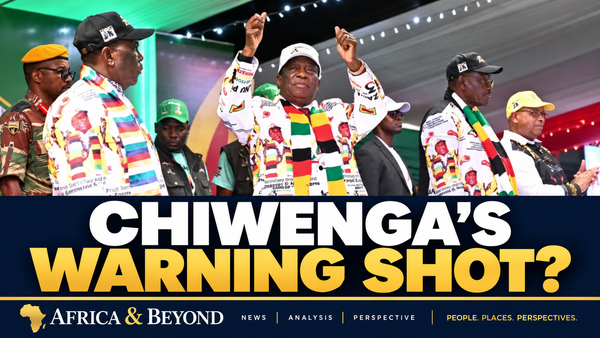
TENDAI BITI BLASTS TAGWIREI APPOINTMENT, RAISES QUESTIONS OVER STATE CAPTURE AND PUBLIC FUNDS
Tendai Biti has criticised Kudakwashe Tagwirei’s appointment as Economic Development Minister, raising questions about Command Agriculture, Treasury Bills, fuel contracts, conflicts of interest and public accountability.


HARARE, Zimbabwe — Former Finance Minister Tendai Biti has launched a blistering attack on President Emmerson Mnangagwa’s appointment of businessman Kudakwashe Tagwirei as Minister of Economic Development and Investment Promotion, warning that the move raises serious questions about the relationship between political power, private business interests and the management of public resources.
In a strongly worded statement, Biti described the appointment as “a new low” for the Second Republic, arguing that it blurs the line between public office and private enrichment.
Tagwirei’s appointment was announced on 8 October 2026, with Professor Mthuli Ncube reassigned to the Ministry of Finance. The restructuring separates the economic development and investment promotion portfolio from the Treasury portfolio.
Biti argues that Tagwirei’s appointment cannot be viewed in isolation from his extensive business interests and longstanding involvement in government-linked economic programmes.
“The centre of gravity of this regime is looting, extraction and rent. Nothing else,” Biti said, presenting the appointment as evidence of what he regards as a broader problem of political patronage and weak accountability.
His allegations raise questions that require documentary evidence, independent investigation and responses from the individuals and institutions concerned.
THE ‘ARCHBISHOP OF CORRUPTION’
Biti reserved some of his strongest language for Tagwirei’s business dealings, describing him as the “Archbishop of Corruption” and alleging that his commercial interests extend across fuel, mining, construction, banking, supermarkets and other sectors.
His central argument is that a businessman with substantial interests in sectors affected by government policy should face rigorous scrutiny when appointed to a senior economic portfolio.
Tagwirei’s business and political connections have attracted international scrutiny. The United States sanctioned him and Sakunda Holdings in 2020, while the United Kingdom imposed sanctions in 2021. The authorities cited concerns involving corruption and state-backed financial arrangements.
These are allegations and positions advanced by the respective authorities, rather than proof that every transaction involving Tagwirei was unlawful.
For Biti, the issue goes beyond Tagwirei’s commercial history. It concerns whether public institutions can independently scrutinise the interests of individuals who move between business and government.
The government has presented the new ministry as part of its efforts to promote investment and economic growth. Its challenge will be to demonstrate that decisions are transparent, public resources are protected and investors are treated fairly.
COMMAND AGRICULTURE AND THE TREASURY BILL CONTROVERSY
One of Biti’s most serious criticisms concerns Command Agriculture, the government-backed agricultural programme in which Tagwirei’s Sakunda Holdings played a major role.
Biti said a Public Accounts Committee inquiry he chaired examined the companies’ dealings between 2015 and 2018. He alleges that more than US$1 billion was received, largely through Treasury Bills, without adequate evidence of corresponding deliveries of maize and fertiliser.
An investigation by The Sentry also examined the programme’s financial arrangements, raising questions about payments made to Sakunda, the value of agricultural inputs supplied and the accounting of government-backed obligations.
The controversy raises a fundamental question: how were the financial obligations calculated, redeemed and accounted for, and what mechanisms were used to verify that public expenditure delivered the intended agricultural benefits?
Biti also questioned a reported US$1.9 billion Treasury Bill payment linked to the acquisition of a 35 percent stake in Kuvimba Mining when it was placed under the Mutapa Investment Fund.
He alleges that the transaction lacked adequate valuations and justification. These claims require examination against the relevant transaction records, valuations and official accounts.
The broader issue is the need for transparent accounting whenever public financial instruments are used to acquire or transfer interests in strategic national assets.
FUEL, DEMA AND THE COST TO CONSUMERS
Biti also renewed his criticism of Tagwirei’s involvement in Zimbabwe’s fuel and energy sectors, alleging that his business interests have benefited from government decisions at public expense.
He cited the Dema diesel power plant, fuel supply arrangements and the cost of electricity purchased by the Zimbabwe Electricity Supply Authority.
Investigations into Tagwirei’s business networks have examined his role in the fuel market, including arrangements involving international commodities trader Trafigura, fuel supplies and state-linked financing.
These issues warrant scrutiny of procurement procedures, contract pricing, tax arrangements and the allocation of risks between private companies and the state.
For ordinary Zimbabweans, the concern is whether expensive or opaque arrangements ultimately contribute to fuel prices, electricity bills and the wider cost of doing business.
Determining whether particular contracts caused specific price increases requires detailed financial and contractual evidence. Biti’s allegations should therefore be tested against procurement records, audited accounts and responses from the companies and public institutions involved.
WHY THE APPOINTMENT RAISES CONFLICT-OF-INTEREST QUESTIONS
Tagwirei’s new portfolio is responsible for economic development and investment promotion, while Ncube remains Finance Minister.
This distinction matters. Tagwirei has not directly replaced Ncube as the minister responsible for Treasury, but his new position places him at the centre of the government’s investment and economic development agenda.
Biti’s concern is whether a minister with extensive private commercial interests can exercise public authority without conflicts arising between official responsibilities and business connections.
The government should clarify how such conflicts will be identified and managed, including whether the minister must disclose relevant interests, recuse himself from decisions affecting associated businesses and submit transactions to independent scrutiny.
The appointment also presents an investment credibility challenge.
Tagwirei remains subject to US and UK sanctions, according to published reports. Those restrictions may complicate dealings with some international financial institutions and businesses, depending on the parties involved and the applicable sanctions rules.
The government says it wants to attract investment. Its ability to do so will depend not only on commercial experience but also on investor confidence in transparency, predictable regulation and safeguards against conflicts of interest.
CONSTITUTIONAL AMENDMENT NO. 3 ENTERS THE DEBATE
Biti also challenged the political and constitutional circumstances surrounding Tagwirei’s rise into government.
Tagwirei was recently appointed to the Senate under the arrangements introduced through Constitutional Amendment No. 3 before his elevation to Cabinet. Critics have questioned the amendment and its implications for presidential appointment powers.
Biti argues that a contested constitutional process cannot simply be treated as beyond challenge because the government has proceeded with appointments.
The legal position must be determined through the applicable constitutional provisions and any relevant court proceedings. Political objections alone do not establish that an appointment is legally void.
Nevertheless, the dispute adds another dimension to questions about executive authority, accountability and the concentration of political and economic influence.
‘THE CATTLE THIEF AND THE HERDSMAN’
Biti concluded his statement with a village analogy involving a notorious cattle thief named Faranisi, who was appointed by a headman to guard the community’s livestock.
According to Biti’s account, villagers protested because the person entrusted with protecting their cattle was himself accused of stealing livestock.
The former Finance Minister used the story to illustrate what he sees as the contradiction of placing a controversial businessman in a position of public responsibility.
The analogy is political rhetoric rather than proof of criminal conduct. Its message is that public appointments involving individuals with substantial commercial interests require credible safeguards and public accountability.
THE QUESTIONS MNANGAGWA’S GOVERNMENT MUST ANSWER
The appointment places several issues under renewed scrutiny.
Command Agriculture: Can the government provide a comprehensive account of Treasury Bills issued, agricultural inputs delivered and outstanding financial obligations?
Kuvimba and Mutapa: What valuations, approvals and transaction documents support the financial arrangements involving state-linked mining interests?
Fuel and energy: Were contracts awarded competitively, and did their terms protect the interests of consumers and taxpayers?
Conflicts of interest: What enforceable measures will prevent the new minister from influencing decisions that could benefit his private commercial interests?
Investment credibility: How will the government address concerns arising from international sanctions and scrutiny of Tagwirei’s business dealings?
Constitutional accountability: What legal arguments and safeguards underpin the appointments made under the disputed constitutional changes?
These questions cannot be resolved by political statements alone. They require access to records, independent audits, parliamentary oversight and meaningful opportunities for the parties concerned to respond.
For Zimbabweans facing high living costs, pressure on public services and persistent concerns over the management of national resources, the issue is ultimately about whether economic policy serves the public interest.
Biti’s intervention has placed that question at the centre of the debate over Tagwirei’s appointment. The government’s response, and the transparency of decisions made under the new ministry, will be important tests of its commitment to public accountability.
FULL STATEMENT BY TENDAI BITI
THE APPOINTMENT OF KUDAKWASHE TAGWIREI: A NEW LOW FOR THE SECOND REPUBLIC
The shocking appointment of Kudakwashe Tagwirei as Minister of Economic Development is a new low, even by the vacuous standards of the self-proclaimed Second Republic.
It is breathtaking arrogance and hubris on the part of Mnangagwa. A statement that he is untouchable and oblivious of the national mood and national interest.
We have consistently argued that the centre of gravity of this regime is looting, extraction and rent. Nothing else.
It is this mafia mentality that has driven the 2030 Agenda and is bringing the country to a point of no return through the unrelenting pursuit of the ill-fated Constitutional Amendment No. 3.
This appointment of Kuda conflates the line between power and private enrichment. It is the personification of State Capture. The Gupturisation of the Republic.
THE ARCHBISHOP OF CORRUPTION
Kuda Tagwirei is the kingpin of massive extraction. His shadow permeates every corridor of looting, from fuel, mines, construction, tenders, banks, supermarkets and even churches.
He has an incestuous relationship with Treasury, has received more Treasury Bills than anyone, and purely on the basis of conflict of interest cannot be a government minister.
Tagwirei was a major beneficiary of Command Agriculture.
The Public Accounts Committee I chaired investigated his companies 2015–2018. We found over US$1 billion received, mostly in Treasury Bills. We could not find a single bag of maize or fertiliser delivered in return.
Those questions have never been answered.
On 20 January 2019, he received a US$360 million Treasury Bill. Under SI 33 of 2019, all foreign obligations were converted to local currency. His Treasury Bill escaped the haircut.
In June/July 2019, he flooded the market with that US dollar Bill and the RTGS collapsed. RBZ froze accounts, IMF raised concerns, then nothing.
He has benefited from numerous other Treasury Bills with no comprehensive account from the Minister of Finance.
Most notorious is the US$1.9 billion payment for 35% of shares in Kuvimba Mining when it was placed under the Mutapa Fund.
The US$1.9 billion Treasury Bill was paid out without valuations or justification.
This Treasury Bill, like Command Agriculture, is a criminal docket on its own.
A VICE-LIKE GRIP ON FUEL
Tagwirei controls Zimbabwe's US$4 billion fuel industry.
He was awarded the Dema diesel plant contract and ZESA was forced to buy power at 34 US cents per kWh while Eskom imports were 12 cents. The public paid the difference.
Millions of litres of duty-free diesel for Dema were diverted and sold on the market.
Zimbabweans pay some of the highest fuel prices in the region. A large part is levies and rents that ultimately end in Tagwirei's pockets.
A PATTERN THAT DEMANDS INVESTIGATION
He has been linked to land and title deeds, First Mutual Life shares, and shares in two major banks.
These need forensic audits, not political slogans: all Treasury Bills, Command Agriculture, Dema, fuel, Kuvimba, Mutapa, Trababalas Interchange, roads and churches.
To then place a criminal like Tagwirei in a Treasury Ministry responsible for national coffers is an act of treason. It brings the country into disrepute.
More so when the appointment itself is void. Constitutional Amendment No. 3 is contested. Courts must decide. You cannot wish away the Constitution by exercising power.
THE CATTLE THIEF AND THE HERDSMAN
In Gandanzara village there was a notorious cattle thief, Faranisi. He stole goats, cattle, sheep and terrorised villages.
One day headman Zvaendwa of the Nyati totem appointed Faranisi to guard the village cattle (kuenda kujana).
The village erupted. They went for Nyati and demanded he remove Faranisi.
The cattle thief has been appointed to herd the cattle.
We must not stay silent.
Cry, the beloved country. Cry.
#Zimbabwe #Tagwirei
Africa & Beyond — News | Analysis | Perspective
Editorial note: The statement above reproduces Biti’s supplied text, with spelling, punctuation and formatting corrections for readability. Allegations remain attributed to Biti and have not been independently established by their inclusion here.