
OPINION: Harare’s Vendor Crackdown Cannot Become a War on Survival

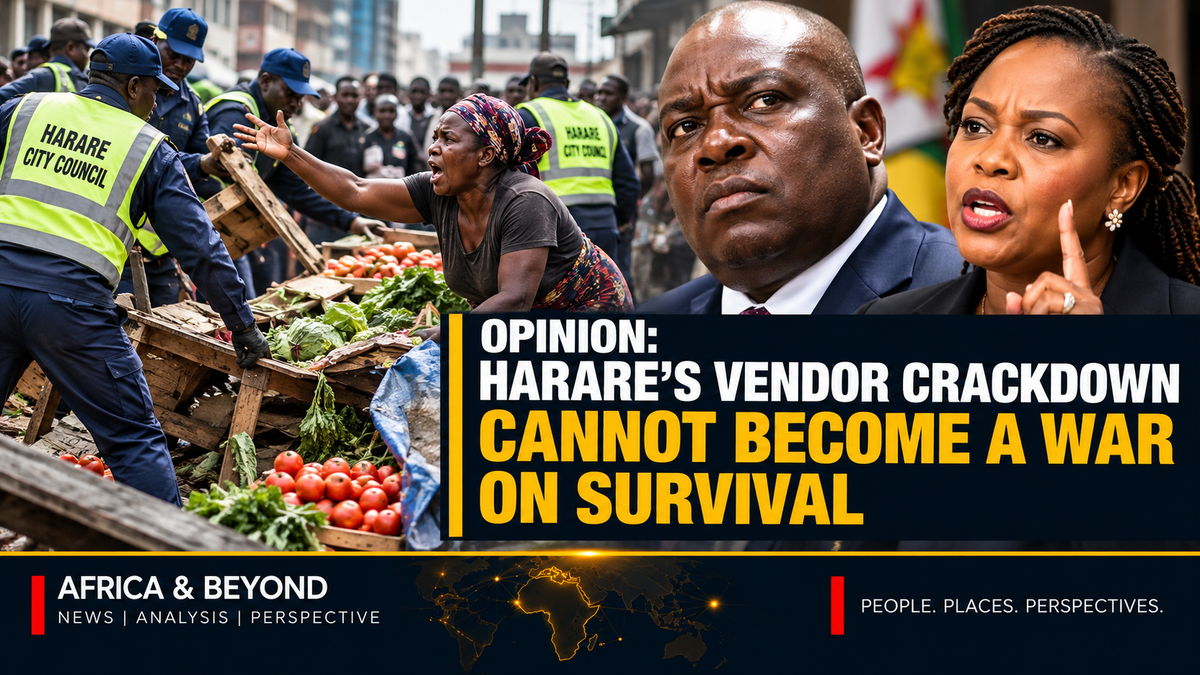
HARARE — There is a difficult question at the heart of Harare's latest clean-up operation: what happens to people whose only available economic activity is the very informal trade that authorities are now trying to remove from the streets?
The Government and Harare City Council have presented the operation as an urban regeneration and decongestion programme designed to restore cleanliness, public safety, trafficability and order.
But there is another side of the story that cannot be swept away with the rubbish.
For thousands of Zimbabweans, vending is not simply an urban-planning problem.
It is an income. It is food on the table. It is school fees. It is rent. It is transport money. It is survival.
And that distinction matters.
Zimbabwe cannot regulate away the economic reality
Zimbabwe's economy is overwhelmingly informal.
ZIMSTAT's Economic Census found that 76.1% of the 204,798 operational establishments identified were informal.
ZIMSTAT's second-quarter 2025 labour-force data also shows the scale of informal employment, with more than two million people recorded as informally employed.
These numbers should fundamentally change how policymakers think about vending and informal enterprise.
When the formal economy does not absorb enough people, informal enterprise becomes one of the mechanisms through which households survive.
A street vendor is therefore not simply someone standing in the way of a government's vision of a modern city.
There is a person behind that stall.
And behind that person may be children, parents, rent, school fees, medical bills and an entire household depending on the day's sales.
You cannot formalise an economy by chasing away its informal workers
This is where the Government's approach deserves serious criticism.
If the stated objective is to formalise the informal economy, then the starting point should be removing the barriers that prevent people from becoming formal.
It should not be to make informal survival increasingly impossible.
Formalisation means making registration affordable.
It means simple licensing.
It means reasonable taxes.
It means access to finance.
It means affordable premises.
It means serviced markets.
It means reliable infrastructure.
It means creating pathways through which a woman selling vegetables today can become the owner of a registered grocery business tomorrow.
It means creating an economy where formal employment and formal enterprise are realistic alternatives.
You do not create formal businesses by destroying informal businesses.
You create them by making the formal economy accessible.
Government chose enforcement first
Minister of Local Government and Public Works Daniel Garwe gave vendors operating from undesignated areas a September 9 deadline to relocate to authorised trading sites. Government described the operation as necessary to restore order, sanitation, public safety and the proper use of urban spaces.
Harare Mayor Jacob Mafume and Garwe subsequently launched the urban regeneration and decongestion operation.
The City said vendors operating illegally in the CBD should relocate to designated areas and that vendors operating in suburbs would also have access to designated places. It also deployed municipal police to enforce the operation.
The crackdown did not remain confined to the CBD.
By September 22, Government reported that 2,475 businesses had been affected and 1,137 illegal structures removed under Operation Chenesa in Harare.
That is no longer simply a clean-up of a few pavements.
It is a major intervention into the livelihood system of a city whose residents have increasingly depended on informal commerce.
The Government says formalisation is coming
Government has since announced a 60-day formalisation drive, saying it will provide more and upgraded trading spaces and assist informal traders to enter the regulated economy.
It says 100 identified vending sites across Harare's suburbs are to be serviced with water, ablution facilities, lighting, shelter, waste management and storage. Government has also announced a formalisation programme and plans to link formalised vendors with financial institutions.
Those measures deserve scrutiny — because implementation, not announcements, will determine whether this becomes genuine economic transformation.
The Government says charges at designated markets have been reduced from an initial proposed US$100 per month to US$45, with traders given six months to operate without paying.
That is precisely where the policy must now be tested.
Are the markets where customers actually go?
Can vendors make enough money there to survive?
Are the facilities ready?
Are the fees affordable after the grace period?
Can vendors access working capital?
Can a small trader actually graduate from a stall into a sustainable formal business?
Those are the questions that matter.
A market without customers is not an economic solution
A vendor removed from a busy pavement and sent to a market where customers do not go has technically been relocated.
Economically, however, that person may simply have been put out of business.
A market without customers is not an economic solution.
A licence without affordable operating conditions is not necessarily formalisation.
A clean pavement should not become evidence of successful policy if the cost of that cleanliness is thousands of households losing their only source of income.
Harare itself has acknowledged the need for designated and serviced trading areas, while Government has promised to upgrade them.
The success or failure of the programme will therefore depend on whether those alternatives function as real businesses, not merely as places where displaced traders can legally stand.
The danger of treating poverty as disorder
There is a deeper issue here.
Authorities see congestion, litter, blocked pavements and unregulated commerce.
The trader sees breakfast.
The authority sees a by-law.
The trader sees school fees.
The authority sees an illegal stall.
The trader sees the day's rent.
Both realities can exist at the same time.
But government policy becomes irresponsible when it treats the visible manifestation of poverty as though removing it removes the poverty itself.
It does not.
Clear a pavement and unemployment remains.
Remove a stall and poverty remains.
Confiscate goods and the household still needs food.
Push vendors from the CBD into suburbs and the economic problem follows them.
That is why enforcement cannot be the economic strategy.
What about the taxes?
Zimbabwe has spent years expanding taxation and regulation of economic activity.
But taxation cannot be separated from the question of whether people have a viable economic environment in which to operate.
If Government wants informal businesses to become formal, then formalisation must offer tangible advantages.
The state cannot expect the informal trader to carry the obligations of a formal business while receiving none of the stability, infrastructure, finance or market access that make formal enterprise sustainable.
And this is the central contradiction:
Zimbabwe needs more formal businesses and more formal employment, but the route to achieving that cannot simply be to eliminate the informal businesses that currently provide livelihoods.
The informal sector should be treated as a pipeline into the formal economy — not as an enemy of it.
Mahere's response: the issue has now become political
Opposition politician and lawyer Fadzayi Mahere has responded angrily to the treatment of vendors.
Writing on X, she said:
“Zvamurikuitira mavendor izvi muchazvidemba.”
She called for an alternative that allows people to earn a living without what she described as cruelty.
She contrasted the treatment of poor vendors with wealthy people enjoying luxury lifestyles and specifically referred to mothers selling bananas and vegetables to support their children.
She ended:
“Musatsondorese varombo. We need new leaders.”
Mahere's intervention is unmistakably political.
She is not merely debating municipal planning.
She is using the treatment of vendors to make a broader argument about economic justice, government priorities and political leadership.
What Mahere means politically
First, she is changing the frame of the debate.
Government's frame is urban management — order, cleanliness, congestion, public spaces and enforcement. The City has explicitly described Chenesa Harare in those terms.
Mahere's frame is human survival and political accountability.
Her question is effectively: what happens to the person whose livelihood has been removed?
Second, she is drawing a political contrast between the treatment of poor citizens and the treatment of wealthy and powerful people.
Her references to luxury cars and alleged corruption are political rhetoric and should not be treated as proof of wrongdoing by particular individuals.
But the political message is clear: the state should not exercise its strongest enforcement powers against vulnerable people while questions about inequality and accountability remain unresolved.
Third, her statement that “We need new leaders” takes the argument beyond vending.
She is presenting the crackdown as an example of what she sees as a broader failure of political leadership.
In political terms, she is asking citizens to judge government not only by whether Harare's streets look cleaner, but by whether government policy improves the lives of the people who live and work there.
That is a political argument. Citizens will ultimately decide whether they accept it.
But the streets cannot simply be abandoned
Criticising the crackdown does not mean pretending Harare has no urban problems.
The city needs clean streets.
It needs functioning pavements.
It needs waste collection.
It needs regulated commerce.
It needs safe public spaces.
It needs businesses to operate under clear rules.
The question is how those objectives are achieved.
Government says it wants organised development rather than an end to vending altogether. Garwe has explicitly said: “We are not saying no to vending.”
That statement now needs to be measured against reality.
If vending is allowed only in places where traders cannot survive, then the policy has effectively said no to vending without formally saying so.
If formalisation is genuinely the objective, then the formal economy must become attractive enough for people to enter voluntarily.
A modern city cannot be built by making poor people invisible
Harare deserves clean streets.
It deserves functioning roads.
It deserves proper waste management.
It deserves regulated commerce.
But Zimbabwe also needs livelihoods.
The two objectives are not mutually exclusive.
If authorities want vendors out of undesignated spaces, then they must provide designated spaces that actually work.
If they want informal businesses formalised, they must make formalisation affordable.
If they want taxes and licences, they must provide infrastructure and services.
If they want compliance, they must apply the rules consistently.
And if they want the public to believe that the operation is humane, the measure cannot simply be how many streets have been cleared.
It must be whether the people removed from those streets have been given better economic opportunities.
The real measure is whether a mother who sold vegetables yesterday still has a realistic way of feeding her children tomorrow.
Africa & Beyond Perspective
The Government and Council should be challenged on a basic economic principle:
If informality is the problem, remove the barriers to formality — not the people.
Zimbabwe's own statistics demonstrate the enormous scale of informal economic activity.
That scale cannot simply be policed away.
It has to be transformed.
And transformation requires more than municipal police.
It requires jobs.
It requires capital.
It requires affordable regulation.
It requires functioning markets.
It requires infrastructure.
It requires access to finance.
It requires a formal economy that ordinary Zimbabweans can actually enter.
Until that happens, chasing vendors from the CBD, into suburbs and from one trading location to another risks becoming a recurring confrontation rather than an economic solution.
You cannot police your way out of unemployment.
You cannot formalise poverty by destroying the livelihoods people have created to survive.
If Zimbabwe wants a formal economy, it must first make the formal economy accessible.
Africa & Beyond — News | Analysis | Perspective