NATIONAL SPORTS STADIUM: MAKUMIRE DEMANDS ANSWERS ON COST, SAFETY AND ACCOUNTABILITY
Chiredzi Central MP Blessing Ropafadzo Makumire says he will question government over the National Sports Stadium upgrade, its cost and outstanding works, as well as the death of a supporter and wider crowd-management and security concerns.

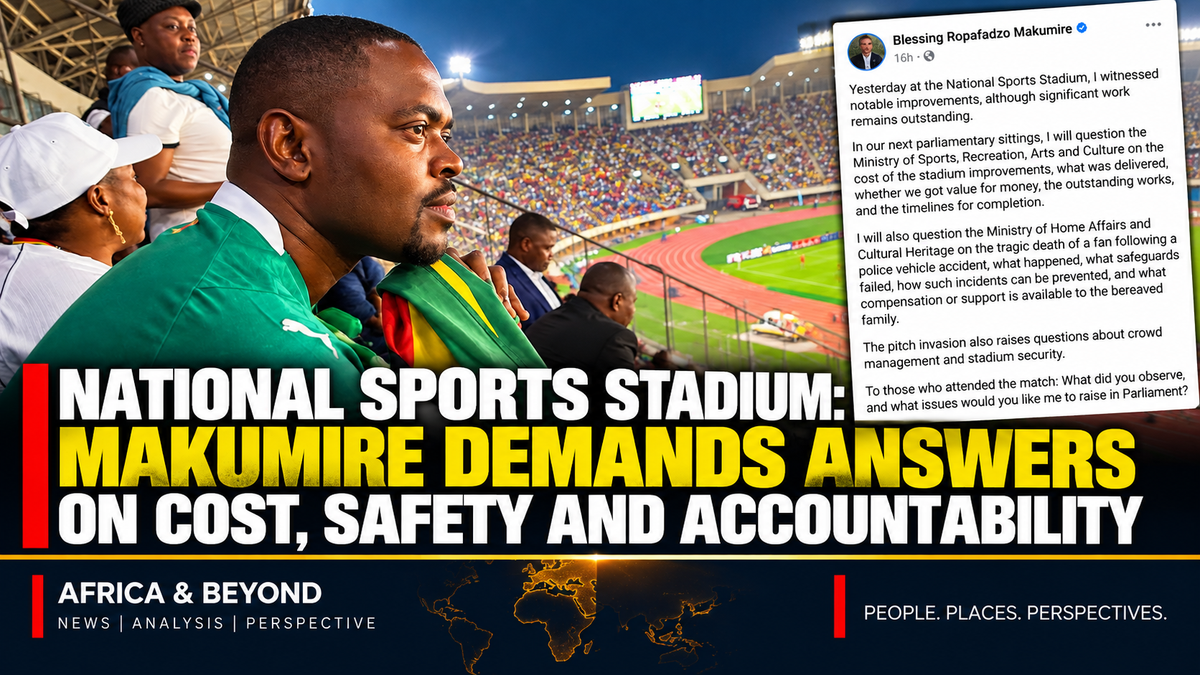
The controversy surrounding Zimbabwe’s National Sports Stadium is moving from the terraces to Parliament, with Chiredzi Central MP Blessing Ropafadzo Makumire saying he intends to demand answers over the cost of the stadium improvements, outstanding works and the death of a football supporter during the Zimbabwe–DRC match.
In a statement published after Monday’s match, Makumire said he had witnessed “notable improvements” at the stadium but added that “significant work remains outstanding.”
He said his parliamentary questions would focus not only on what was delivered, but also on whether Zimbabwe received value for the money spent.
HOW MUCH DID THE UPGRADE COST — AND WHAT WAS DELIVERED?
Makumire said he intends to question the Ministry of Sports, Recreation, Arts and Culture on five central issues:
- the cost of the stadium improvements;
- what was actually delivered;
- whether the project provided value for money;
- what works remain outstanding; and
- when those outstanding works will be completed.
Those questions go directly to the issue of public expenditure.
A stadium upgrade involving public resources should ultimately be capable of being measured against its original scope, cost, specifications and completion schedule.
If additional works remain outstanding, the public should know what they are, why they remain unfinished and whether they represent additional expenditure.
The question of value for money is equally important.
A modernised stadium is not simply about how the facility looks on match day. It is about whether the infrastructure delivered corresponds with what taxpayers were promised and whether it can safely handle large crowds.
THE DEATH AT THE STADIUM
Makumire also said he would question the Ministry of Home Affairs and Cultural Heritage about the death of a football fan following what he described in his post as a police vehicle accident.
The Zimbabwe Republic Police has confirmed that one person died during an incident at Gate Two involving a police public-order vehicle and a pedestrian. Police described the incident as occurring during a stampede and said investigations were underway.
Makumire says Parliament must establish:
What happened?
What safeguards failed?
How can such incidents be prevented?
And perhaps most importantly for the bereaved family:
What compensation or support is available to them?
These questions are now particularly important because the circumstances surrounding the death remain contested.
CROWD MANAGEMENT UNDER SCRUTINY
Makumire has also raised concerns about what he calls the “pitch invasion” and its implications for crowd management and stadium security.
The questions extend beyond the incident that resulted in the death.
A stadium capable of hosting tens of thousands of people requires a comprehensive safety system covering ticketing, entrances, crowd movement, policing, emergency response, security personnel and evacuation procedures.
If any part of that system fails, the consequences can be serious.
The responsibility for crowd safety therefore cannot simply be placed on supporters.
Authorities and stadium managers must demonstrate that adequate systems were in place and that those systems were properly implemented.
THE ELECTRONIC TICKETING QUESTION
The stadium's electronic ticketing system has also been presented as one of the improvements associated with the facility.
The Herald published a post saying there were “no queues to enter the National Sports Stadium”, attributing this to the electronic system installed as part of the stadium upgrade.
But the events around Gate Two have raised questions about whether the overall entry and crowd-management arrangements performed as intended.
That does not automatically mean the electronic ticketing system caused the incident.
It does, however, make it reasonable for Parliament to ask whether the technology was fully operational, whether enough entry points were available and whether contingency arrangements existed in case the system failed or crowds became concentrated.
PARLIAMENT NOW HAS AN OPPORTUNITY
Makumire's intervention creates an opportunity for Parliament to move the stadium controversy beyond social-media arguments and into a formal process of accountability.
The public deserves documentation.
How much was budgeted?
How much was actually spent?
Who carried out the works?
What procurement process was followed?
What was completed?
What remains unfinished?
Were there variations to the original contract?
Were additional payments made?
And who certified the completed works?
These questions are not about attacking the stadium.
They are about establishing whether public money produced the public infrastructure that was promised.
THE HUMAN COST CANNOT BE LOST
The financial questions are important, but the death of a supporter places a much more immediate obligation on authorities.
Someone went to watch a football match and did not return home.
The family now needs answers about what happened.
If a police vehicle was involved, the investigation must establish the circumstances fully.
If crowd-control measures contributed to the incident, that must be established.
If stadium arrangements contributed, that must also be established.
And if the investigation finds that no individual or institution was at fault, that conclusion should be supported by evidence.
An investigation should not simply identify a convenient description of the incident.
It should reconstruct what happened.
ACCOUNTABILITY SHOULD FOLLOW THE EVIDENCE
Makumire's proposed questions are therefore important because they connect two issues that are often treated separately:
the money spent on the stadium and the safety of the people using it.
A facility can be expensive and visually impressive while still having unresolved operational weaknesses.
Conversely, a problem at a stadium does not automatically prove that the entire upgrade was a failure.
The facts need to be established.
That is precisely what Parliament is supposed to do when public expenditure, public infrastructure and public safety intersect.
AFRICA & BEYOND PERSPECTIVE
Zimbabwe does not need another cycle in which a public controversy generates outrage, officials promise investigations and the matter eventually disappears from public attention.
Makumire is putting specific questions on the parliamentary agenda: how much was spent, what was delivered, what remains unfinished, what happened to the supporter who died, which safeguards failed and what support will be provided to the family.
Those questions deserve substantive answers.
If the stadium upgrade delivered value for money, the responsible authorities should be able to demonstrate it.
If shortcomings remain, they should be acknowledged and addressed.
If safety procedures failed, those failures should be identified.
And if responsibility lies with particular individuals or institutions, accountability should follow the evidence.
The National Sports Stadium was upgraded to serve the public.
The public therefore has a legitimate right to know what it paid for, what it received and whether the facility is genuinely safe.
Africa & Beyond — News | Analysis | Perspective