42 Masvingo Chiefs Vote to Recall Charumbira and Two Others From Chiefs Council
Forty-two of 45 Masvingo chiefs have voted to recall Chief Fortune Charumbira and two other chiefs from the National Council of Chiefs, potentially costing all three their Senate seats.

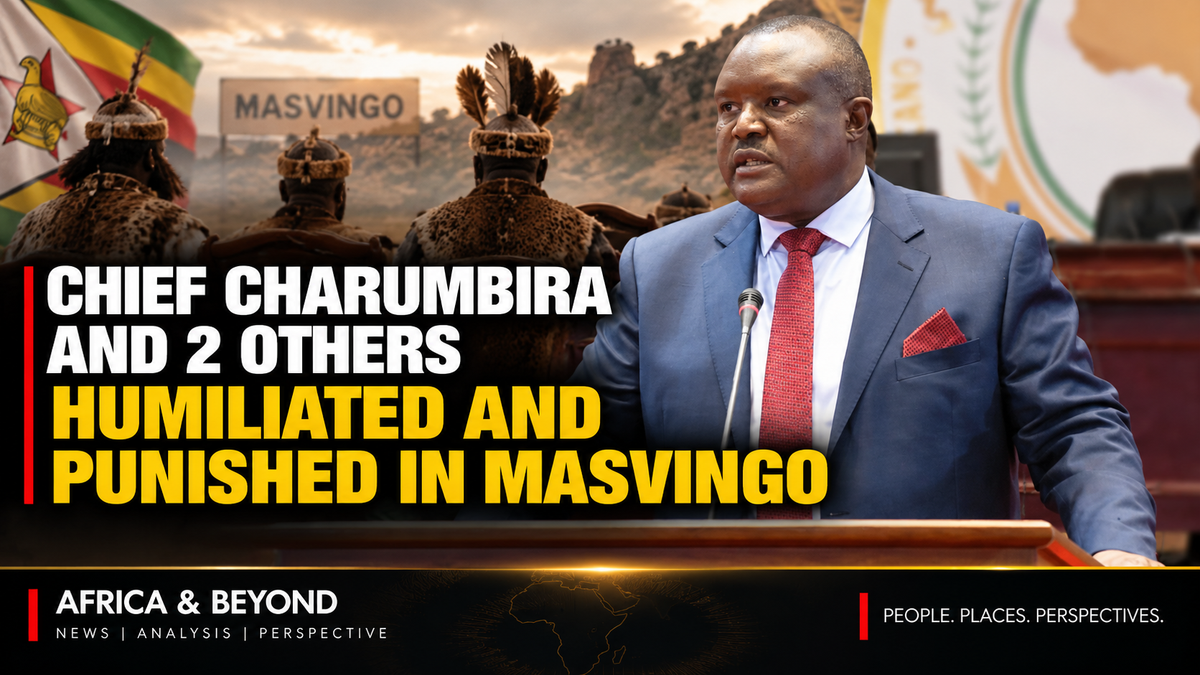
A major shake-up is unfolding among Zimbabwe's traditional leaders after 42 of 45 Masvingo chiefs voted to recall Chief Fortune Charumbira and two other chiefs from the National Council of Chiefs.
The vote, held during a Masvingo Provincial Chiefs Assembly meeting, also targeted Chief Chitanga, born Feleni Chauke of Mwenezi, and Chief Nhema, born Rangarirai Bwawanda of Zaka.
If the decision is formally implemented, the three chiefs would also lose their seats in the Senate.
Chief Chitanga confirmed the vote, saying the three had effectively been “booted out”.
The motion was reportedly moved by Chief Nemanwa, born Fungai Manjiva, who was only recently appointed to the chieftainship and whose jurisdiction includes the Great Zimbabwe area.
No reasons officially given
Despite the overwhelming vote, no formal reasons were publicly given for the proposed recalls.
That has fuelled speculation over whether the development is connected to the increasingly heated political contest surrounding ZANU PF's succession and proposed constitutional changes.
Masvingo Provincial Affairs Minister Ezra Chadzamira and ZANU PF provincial chairman Rabson Mavenyengwa were reportedly present at the meeting.
Their presence has added to questions about the political context surrounding the vote, although their attendance does not by itself establish that the recalls were politically directed.
The developments come amid growing political tensions within ZANU PF over constitutional changes and President Emmerson Mnangagwa's political future.
Charumbira's position makes the move significant
Chief Fortune Charumbira is not an ordinary member of the traditional leadership structure.
He previously served as president of the National Council of Chiefs and is currently its deputy president, under Chief Lucas Mtshane Khumalo of Matabeleland North.
His position also gives him a seat in the Senate.
The possible removal of Charumbira and the two other Masvingo chiefs would therefore have consequences beyond the traditional leadership structure.
It could alter the province's representation in the upper house of Parliament.
Why the Senate matters
Traditional leaders have a constitutionally guaranteed presence in Zimbabwe's Senate.
Sixteen chiefs — two from each of the eight non-metropolitan provinces — are elected to the chamber, while the president and deputy president of the National Council of Chiefs also sit in the Senate.
This gives traditional leaders a total of 18 seats in the 90-member Senate.
The political importance of those seats has increased following Constitutional Amendment No. 3, which extended Mnangagwa's term to 2030 and changed the mechanism for electing the President.
Under the amended system, the President would be elected through a joint vote of members of Parliament, increasing the significance of parliamentary numbers.
Political neutrality under scrutiny
Zimbabwe's Constitution requires traditional leaders to remain politically neutral.
That constitutional requirement has long existed alongside accusations from critics that traditional leaders have become increasingly involved in partisan politics.
The latest developments could therefore reignite questions about the relationship between traditional leadership, the ruling party and national politics.
The reported presence of senior ZANU PF officials at the Masvingo meeting is likely to intensify those questions.
However, without an official explanation for the recall motion, it would be premature to conclude that the three chiefs were removed specifically because of their political positions.
Chitanga faces separate community allegations
Chief Chitanga has also faced criticism over land-related disputes in Mwenezi.
Some residents in the Chingwizi area have previously been involved in disputes surrounding land, resettlement and traditional authority.
There have also been longstanding tensions over land and traditional leadership in Masvingo more broadly. Academic research has documented how land claims, chieftainship boundaries and political influence have become intertwined in the province.
However, allegations that Chief Chitanga's removal was specifically connected to alleged assistance with land grabs in Chingwizi have not been established as the official reason for the recall.
That distinction will be important as the story develops.
What happens next?
The provincial chiefs' vote does not necessarily mean that the three chiefs have immediately lost their positions or Senate seats.
The formal procedures required to give effect to the recall will determine what happens next.
The development nevertheless represents an extraordinary challenge to three senior traditional leaders, particularly Charumbira, who occupies a senior national position within the chiefs' council.
It also raises broader questions about the independence of Zimbabwe's traditional leadership institutions at a time when the political stakes surrounding the Senate and constitutional reform are unusually high.
For now, the central unanswered question is simple:
Why did 42 of 45 Masvingo chiefs vote to remove three of their colleagues?
Until the authorities or the chiefs' structures provide a formal explanation, the political motives behind the decision remain a matter of intense speculation.
Africa & Beyond — News | Analysis | Perspective