
Zimbabwe's Power Crisis: Government Under Pressure to Deliver
Zimbabwe’s power sector faces a major delivery test as government pushes ZESA reforms and new generation projects. Despite improvements, years of delays raise questions over whether Zimbabwe can deliver reliable electricity to households and businesses.

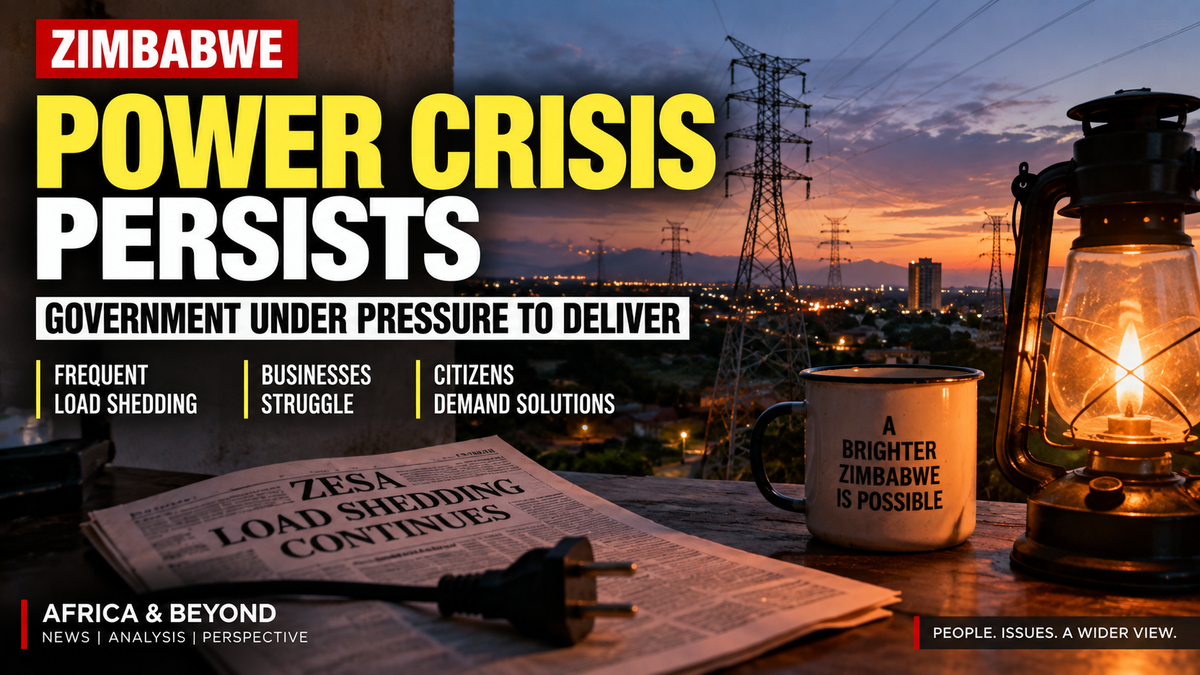
Zimbabwe's electricity sector is once again facing a crucial test as the government attempts to turn years of promises, restructuring and planned investments into reliable power for households and businesses.
Although electricity generation has improved from some of the worst periods of shortages, Zimbabwe still faces a fundamental gap between available supply and growing demand. The World Bank says power shortages continue to impose significant economic costs, affecting mining, agriculture, manufacturing, tourism and households.
The pressure on authorities is therefore no longer simply about keeping the lights on from one day to the next. It is about whether Zimbabwe can build enough dependable generation and a stronger electricity network to support economic growth.
Generation has improved — but the bigger problem remains
ZESA's latest generation snapshot, updated on September 11, showed total generation of 1,424MW, comprising 930MW from Hwange, 30MW from Hwange Expansion, 415MW from Kariba and 49MW from independent power producers. ZESA's figures provide evidence that the country's generating position is stronger than during some previous periods of severe shortages.
But generation on a particular day should not be confused with a permanent solution to Zimbabwe's electricity problem.
Demand continues to grow, particularly from mining and other productive sectors. The World Bank has warned that Zimbabwe's electricity demand is expected to rise substantially, making further investment in generation and the national grid essential.
That leaves government with a difficult challenge: increasing supply quickly enough while also dealing with ageing infrastructure, financial constraints, transmission problems and the need for new investment.
Years of delays have come at a cost
One of the clearest examples of Zimbabwe's implementation problem is the 100MW Gwanda Solar Project.
The project was originally awarded in 2014 at an initial EPC cost of US$172 million. It subsequently became embroiled in contractual disputes and litigation and remained stalled for years.
Now, more than a decade after the original award, the Zimbabwe Power Company has issued Intratrek with a Notice to Proceed and given the developer 24 months to complete the project. The revised EPC cost has been reduced to US$132 million.
The project could eventually add useful capacity to the national grid.
But its history also raises a broader question: how many other power projects will Zimbabwe announce, negotiate and renegotiate before electricity actually reaches consumers?
For a country that needs additional generation urgently, delays of several years can have serious economic consequences.
ZESA is also being restructured
The government has also been reorganising the electricity sector.
ZESA Holdings, the Zimbabwe Power Company and the Zimbabwe Electricity Transmission and Distribution Company have been consolidated into a single vertically integrated entity, ZESA (Private) Limited, with a new board appointed under the restructuring process.
The restructuring is intended to improve coordination and the performance of the electricity utility.
But restructuring alone will not solve Zimbabwe's electricity shortage.
The real test will be whether the new structure results in better maintenance, faster project implementation, improved financial management and more reliable electricity for consumers.
The economic consequences are bigger than blackouts
Zimbabwe's power problem is not only about households sitting in the dark.
Electricity shortages affect factories, mines, farms, shops and small businesses. Companies that cannot rely on the national grid are often forced to invest in solar systems, batteries or generators, increasing their operating costs.
The World Bank estimates that Zimbabwe's power shortages impose substantial economic costs, with unreliable energy affecting productivity and economic growth. It has also identified weaknesses in the financial performance of electricity companies, limited investment and inadequate planning as some of the structural problems behind the country's electricity challenges.
For ordinary consumers, the consequences can appear through higher business costs, increased prices and expensive alternatives to grid electricity.
Government faces a delivery test
The government has repeatedly presented new generation projects and reforms as part of the solution to Zimbabwe's electricity shortages.
The challenge now is converting those announcements into measurable results.
Gwanda Solar is one test.
The performance of Hwange is another.
The reliability of Kariba generation remains important, particularly as Zimbabwe continues to deal with the effects of drought on hydropower.
And the new ZESA structure will ultimately have to demonstrate whether it can deliver better performance than the system it replaced.
Zimbabwe does not lack plans.
What it needs is consistent implementation, transparent contracts, functioning infrastructure and electricity that reaches consumers reliably.
What should Zimbabweans watch?
The coming months will provide important indicators of whether the government's energy strategy is working.
Among them will be the progress of the Gwanda Solar Project, the performance of Hwange and Kariba, the country's reliance on imported electricity, the financial position of ZESA and the pace at which new generation projects move from announcements to actual construction.
For the public, the measure of success will be much simpler.
Are the lights staying on?
That is the standard against which Zimbabwe's electricity reforms will ultimately be judged.
Africa & Beyond — News | Analysis | Perspective