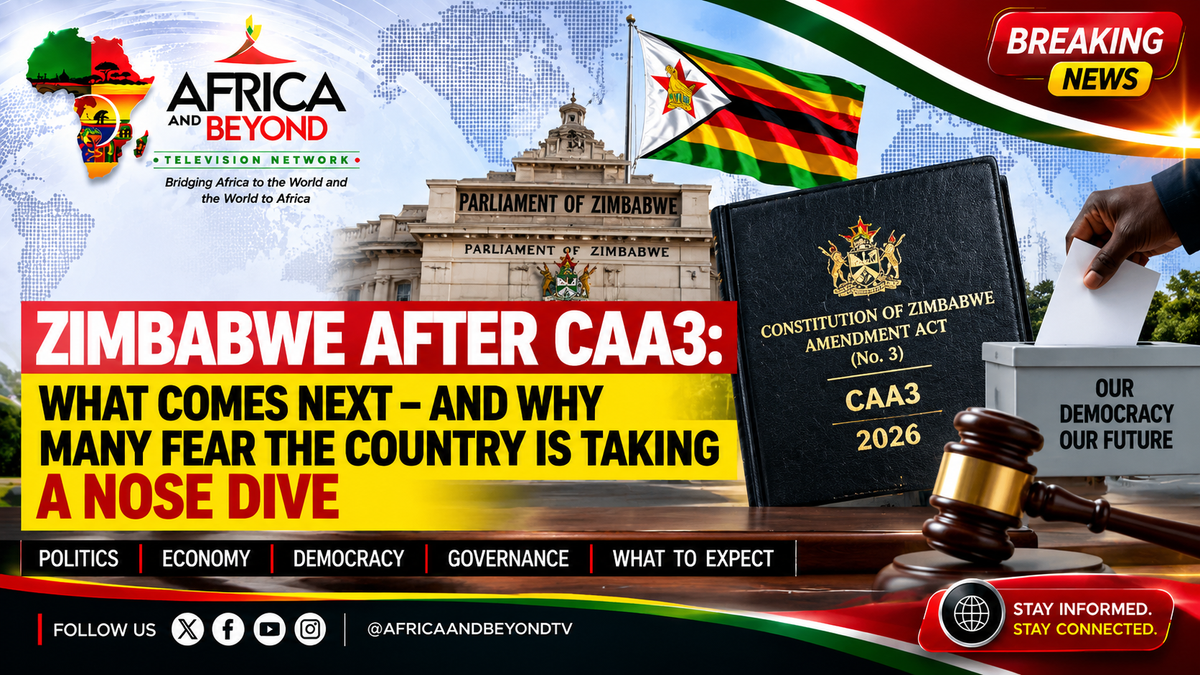
Zimbabwe After CAA3: What Comes Next — And Why Many Fear the Country Is Taking a Nose Dive

By Divine Kurebwa
Analysis | Zimbabwe
Zimbabwe has entered a new and uncertain political chapter.
What began as the Constitution of Zimbabwe Amendment Bill No. 3 (CAB3) has now become law as the Constitution of Zimbabwe Amendment Act No. 3 of 2026 (CAA3) after President Emmerson Mnangagwa signed it on 7 July.
The changes are far-reaching.
The presidential, parliamentary and local-government terms have been extended from five years to seven years. Most controversially, the constitutional amendment changes the mechanism for electing the President, providing for the President to be elected by Parliament rather than directly by voters. The next electoral cycle has consequently been pushed from 2028 towards 2030.
For supporters, the amendment represents constitutional reform. For critics, it represents something much more serious: a fundamental weakening of the citizen's ability to determine who governs the country.
And that is where Zimbabwe's next chapter becomes particularly important.
The question is no longer whether CAB3 will become law
It already has.
The question now is what CAA3 means for Zimbabwe's political system, institutions, economy and ordinary citizens.
CAA3 has already triggered constitutional challenges.
The MDC has taken the amendment to the Constitutional Court, arguing that removing citizens' direct presidential vote affects a right protected under the Constitution's Bill of Rights and should therefore have been subjected to a referendum. The Constitutional Court has set 23 September 2026 for the hearing of that challenge.
That means Zimbabwe has not heard the final legal word on one of the most consequential aspects of CAA3.
Until a competent court says otherwise, however, CAA3 remains in force.
Why this matters beyond politics
It is tempting to treat constitutional amendments as something that happens in Parliament and has little to do with the price of bread, school fees or the cost of building a house.
That would be a mistake.
Political institutions affect economic confidence.
Investors want predictable rules. Businesses want confidence that contracts and property rights will be respected. Citizens want confidence that institutions can hold those in power accountable.
If political uncertainty increases, the consequences can eventually be felt in investment, employment, capital flows and household confidence.
This is why the debate surrounding CAA3 is bigger than the question of who contests the 2030 elections.
It is about institutional confidence.
Is Zimbabwe really taking an economic "nose dive"?
Here, the evidence requires some caution.
Zimbabwe's economic picture is actually mixed.
The IMF says the economy grew strongly in 2025 and continued to show momentum in 2026, supported by agriculture, mining and favourable gold prices. It projects real GDP growth of around 5% in 2026. Inflation has also remained relatively low.
The Reserve Bank of Zimbabwe reported annual ZiG inflation of 2.89% in August 2026, while US-dollar inflation was 3.13%. So, economically, it would be inaccurate to simply declare that Zimbabwe is currently in free fall. But economic stability is not the same thing as broad prosperity.
And this is where the argument becomes more complicated.
Stability on paper, hardship on the ground
Zimbabwe has experienced repeated currency changes, high inflation, debt problems and periods of severe economic instability.
The IMF notes that Zimbabwe remains burdened by major vulnerabilities, including high public debt, external arrears, limited access to international capital markets and weaknesses in monetary-policy credibility.
The country therefore remains vulnerable.
A period of low inflation does not automatically mean that ordinary families are becoming wealthier. A growing economy does not automatically mean that young people are finding jobs. And increased mineral exports do not automatically mean that communities sitting on mineral wealth are seeing meaningful improvements in their living standards.
This is the difference between macroeconomic stabilisation and economic transformation.
The biggest danger: losing public confidence
Perhaps Zimbabwe's greatest challenge is not simply inflation.
It is confidence.
When citizens lose confidence in institutions, they begin looking for alternatives.
Businesses become cautious.
Young people look outside the country for opportunities.
Professionals leave.
Investors demand greater compensation for risk.
And citizens increasingly conclude that the political system works for the powerful rather than the ordinary voter.
That is the danger critics see in CAA3.
If citizens come to believe that their vote is becoming less powerful, political participation itself can suffer.
The 2030 question
CAA3 has fundamentally changed the political timetable.
Instead of Zimbabweans preparing for a presidential election in 2028, the country is now moving towards an electoral cycle extending to 2030.
That gives the government additional time.
But it also creates a major test.
What will Zimbabwe look like in 2030?
Will the additional years be used to strengthen institutions, create jobs, rebuild infrastructure, reduce debt and improve public services?
Or will the extended political timetable simply entrench the existing political order?
That is ultimately the question Zimbabweans should be asking.
What should citizens expect next?
There are several major developments to watch.
1. The Constitutional Court
The September 23 hearing could become one of the defining constitutional cases in Zimbabwe's recent history. The court will have to grapple with whether CAA3's changes to presidential elections affected protected voting rights and whether the amendment process therefore required a referendum.
2. The 2030 political landscape
Political parties now have a longer runway to reorganise, recruit and build support.
The opposition faces an especially important question: can it rebuild an effective political alternative before the next presidential contest?
3. Economic reforms
Zimbabwe needs to convert macroeconomic stability into tangible improvements in people's lives.
The IMF has emphasised continued fiscal discipline, monetary reforms, governance improvements, debt resolution and structural reforms.
4. Institutional independence
The real test of CAA3 may ultimately be whether Zimbabwe's institutions remain sufficiently independent to hold government accountable.
That includes Parliament, the courts, electoral institutions, the media and civil society.
Zimbabwe's crossroads
Zimbabwe is therefore not simply experiencing an economic "nose dive."
The country is at a political and institutional crossroads.
There are encouraging economic indicators. Inflation has fallen dramatically from the extreme levels of previous years, growth has strengthened and the IMF sees an opportunity for further stabilisation.
But those gains can be fragile.
Economic stability without institutional confidence can prove temporary.
Political stability without accountability can become stagnation.
And constitutional change without broad public confidence can deepen polarisation.
Zimbabwe now has time before the next presidential election.
The question is what the country will do with that time.
Will 2030 find Zimbabwe stronger, richer, more democratic and more confident?
Or will the additional years simply have postponed the problems?
That is the real story after CAB3 became CAA3.